
Understanding HTTP/3, QUIC & Brotli: How Modern Protocols Improve Speed and Resilience
Over the last decade, the web has quietly undergone the biggest transport-layer upgrade since HTTP/2. Modern sites are faster, more resilient to network instability, less prone to head-of-line blocking, and far more efficient at delivering assets to end users. The technologies enabling this shift — HTTP/3, QUIC and Brotli — reshape how browsers and servers talk to each other.
This explainer walks you through the problems these protocols solve, how they work under the hood, where deployments fail in the real world, and the practical checklists you can use when optimising your own stack. Whether you’re running a WordPress site, deploying AI-driven microservices, or building distributed inference layers across regions, understanding these protocols is now part of the fundamentals.
If you’re testing how protocol adjustments can improve (or hamper) your site over time, be sure to bookmark and test pre & post deployments using our free speed score analyser.
What Problems Do HTTP/3, QUIC and Brotli Solve?
At a high level, these technologies exist to tackle three long-standing issues:
- Performance degradation on weak, lossy or high-latency networks
- Head-of-line blocking caused by TCP limitations
- Inefficient compression leading to larger payloads than necessary
For years, HTTP/2 solved concurrency and multiplexing, but it built those improvements on top of TCP. TCP was never designed for modern web patterns like parallel streams, edge delivery, or mobile radios rapidly switching between network states. HTTP/3, QUIC and Brotli directly address these bottlenecks.

The Evolution: From HTTP/1.1 to HTTP/3
| Protocol | Transport | Multiplexing | Resilience |
|---|---|---|---|
| HTTP/1.1 | TCP | No | Poor |
| HTTP/2 | TCP | Yes | Moderate (still blocked by TCP) |
| HTTP/3 | UDP (via QUIC) | Yes | High – no TCP head-of-line blocking, fast recovery |
The move from TCP to QUIC+UDP is revolutionary. It essentially reimagines the transport layer while retaining the semantics of HTTP. For WordPress operators, DevOps teams, and AI platform engineers, the gains become especially obvious on mobile connections, international routing, and CDN-proxied environments.
QUIC: The Backbone of HTTP/3
QUIC (pronounced “quick”) is Google’s replacement for TCP, now standardised by the IETF. It runs over UDP but includes features you previously relied on TCP for — congestion control, reliability, ordered delivery — bundled with extra capabilities optimised for the modern web.
Key Concepts
- No head-of-line blocking: Streams operate independently, so a single lost packet does not halt the entire connection.
- Faster connection establishment: QUIC supports 0-RTT, enabling repeat visitors to skip an entire handshake.
- Encryption by default: TLS 1.3 is built directly into QUIC — there is no unencrypted mode.
- Connection migration: Sessions survive IP changes — crucial for mobile users roaming between Wi-Fi and 4G/5G.
Compared with TCP, QUIC behaves more like modern distributed systems architecture: stateless, resilient, and optimised for unpredictable networks. These very properties also align with how AI-driven websites and inference-heavy stacks communicate, especially when scaling across regions or edge nodes.
How HTTP/3 Extends QUIC
HTTP/3 defines how the traditional HTTP semantics — headers, methods, status codes, request/response cycles — map onto QUIC streams. If you think of HTTP/2 as “parallel HTTP/1.1 over TCP”, then HTTP/3 becomes “parallel HTTP over fast, stream-safe QUIC channels”.
The notable improvements include:
- No TCP slow-start penalties
- Better behaviour on lossy networks
- Consistent performance under congestion
- Improved prioritisation of assets
This is especially relevant to media-heavy WordPress sites, WebP-first builds, and complex setups like the full hosting stack for WordPress where the bottleneck often sits in network transfer rather than PHP execution.
Brotli: The Compression Layer that Completes the Stack
Brotli is a modern compression algorithm developed by Google, replacing gzip in the majority of performance-focused environments. It provides much better compression ratios and behaves intelligently with pre-compressed or redundant payloads.
Why Brotli Matters
- Smaller response sizes: Reduces transfer overhead for text-heavy assets such as CSS, JS and HTML.
- Built for HTTPS: Works best with TLS 1.3 and modern CDNs.
- Better dictionary compression: Highly efficient for repeated patterns like JSON structures.
When paired with QUIC and HTTP/3, Brotli removes unnecessary bloat and ensures payloads deliver quickly even when connections switch between networks. This is exactly the kind of optimisation you’ll see referenced in your cdn playbook, where providers like Cloudflare, QUIC.cloud and Fastly lean heavily on Brotli to deliver at edge speed.
How These Protocols Work Together
Think of HTTP/3, QUIC and Brotli as parts of a modern delivery pipeline:
- QUIC handles the transport (connection migration, resilience, packet recovery)
- HTTP/3 defines the semantics (requests, responses, multiplexing)
- Brotli reduces the payload size (fast compression of textual assets)
When combined, they solve problems previous generations of HTTP couldn’t address without significant workarounds.
Common Misconfigurations and Real-World Failures
1. HTTP/3 Only Enabled on the CDN Layer
Many site owners activate HTTP/3 on Cloudflare, Fastly or QUIC.cloud and assume it is globally configured. In reality, some requests still route directly to origin under certain conditions. When that origin lacks QUIC/HTTP/3 support, fallbacks introduce latency.
2. Mixed Brotli/Gzip Configurations
It’s common to see Brotli enabled at the CDN but gzip still active at origin. This leads to:
- Double compression
- Incorrect Vary headers
- Cache partitioning issues
3. Incorrect Prioritisation of Assets
HTTP/3 includes a new prioritisation model. Misconfigured servers can allocate more bandwidth to low-priority assets, harming Largest Contentful Paint.
4. QUIC Blocked by Firewalls
Some enterprise networks block UDP traffic by default. If your audience includes corporate users, fallback behaviour must be carefully tested.
5. Proxy Layers Breaking QUIC Migration
Connection migration — a core QUIC benefit — breaks when intermediate layers terminate connections incorrectly. This most often occurs on multi-CDN setups or during custom routing logic in AI-based infrastructure.
Practical Checklist for Deploying HTTP/3, QUIC and Brotli
The following checklist ensures a clean, production-safe deployment:
HTTP/3 / QUIC Checklist
- Enable HTTP/3 at both CDN and origin where possible
- Test fallback to HTTP/2 and ensure no downgrade loops
- Validate that UDP/443 is open on your hosting provider
- Confirm the server uses TLS 1.3
- Verify connection migration works on mobile networks
- Ensure server supports the correct QUIC draft/versions
Brotli Checklist
- Enable Brotli at the CDN layer
- Disable gzip on origin where duplication may occur
- Ensure correct
Content-Encodingheaders are returned - Double-check Brotli levels (avoid level 11 — too slow for dynamic content)
Infrastructure Considerations
- Test with multiple CDNs if using multi-region failover
- Ensure caching behaviours are consistent with Brotli-encoded assets
- Monitor performance on regions where UDP may be blocked
- Review logs for QUIC version negotiation failures
Why These Protocols Matter for AI-Driven and LLM Hosting
Modern AI-driven websites increasingly rely on multi-region inference, vector database queries, and lightweight edge-deployed models. Protocol-level efficiency directly affects how quickly insights propagate through your system.
For example:
- QUIC’s connection migration prevents inference calls from breaking when users switch networks.
- Brotli compresses JSON-heavy payloads returned by vector search requests.
- HTTP/3 prioritisation helps route crucial requests ahead of cosmetic ones.
This is especially relevant for setups involving vector databases, such as those discussed in your guide to vector dbs in WordPress, where the payloads benefit from Brotli’s dictionary compression. Likewise, distributed inference platforms — such as those in the inference layers article — experience smoother cross-region routing under QUIC.
Even full LLM infrastructure pipelines benefit from these protocols. If you’re deploying models using the approach outlined in your llm hosting infra post or following the blueprint for running llms, reducing network penalties between microservices often yields latency improvements more significant than raw hardware upgrades.
Practical Example: WordPress + CDN + QUIC
To illustrate, here’s a real-world scenario based on a typical WordPress architecture optimised for speed:
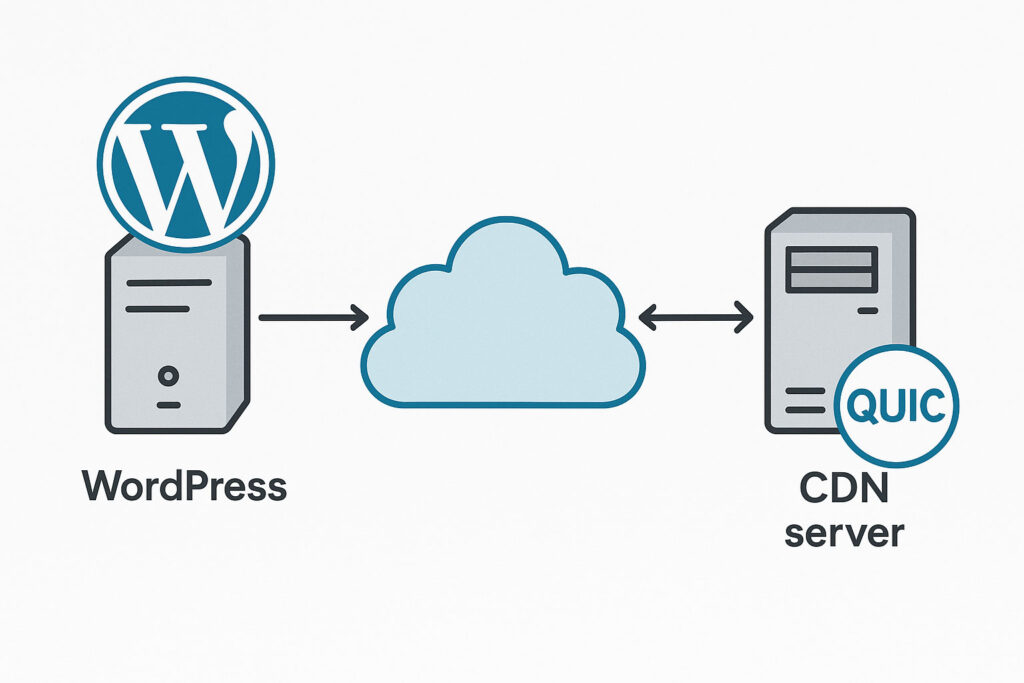
A highly optimised stack might include:
- Edge caching via a CDN (e.g., Cloudflare)
- Brotli enabled at edge
- HTTP/3 and QUIC at both edge and origin
- Server-level caching and minimal PHP execution
- Priority resource hints for LCP assets
The combined result:
- Fewer round trips
- Lower latency on mobile networks
- Reduced CPU load due to smaller payloads
- More stable performance during congestion
In high-traffic events, the improvements in connection stability alone can prevent a site from failing under load.
How to Benchmark These Improvements Yourself
To accurately measure the gains, you should benchmark:
- TTFB on HTTP/2 vs HTTP/3
- Packet loss behaviour across Wi-Fi and 4G/5G
- Compression ratios with Brotli vs gzip
- Connection migration via real mobile device testing
Tools such as WebPageTest, Chrome DevTools and CDN-specific analytics dashboards help isolate whether QUIC is used, how often fallbacks occur, and where asset prioritisation may be failing.
HTTP/3, QUIC & Brotli FAQs
Most modern browsers support HTTP/3, but not all corporate networks allow QUIC traffic. Always test fallbacks.
In most cases yes, but gzip may be used for legacy clients. The key is preventing double compression.
Yes — that is one of its major strengths. Session IDs allow continuity even when the IP changes.
Generally no, but firewalls blocking UDP can affect behaviour. Always test connectivity in restricted networks.
No. On very clean wired connections, gains may be minimal. Benefits are largest on congested or mobile networks.
Conclusion
HTTP/3, QUIC and Brotli form a powerful trio that modernises how the web is delivered. They reduce latency, eliminate long-standing transport-layer bottlenecks, and significantly improve resilience on unstable networks. Whether you’re optimising a WordPress website, scaling an AI-powered platform, or deploying a multi-region inference layer, mastering these protocols is now essential for staying competitive in the performance-driven era of 2025.
If you found this content helpful,please consider sharing!:
More in Hosting
